
Home / Track speed training
Track speed training in the metro-east
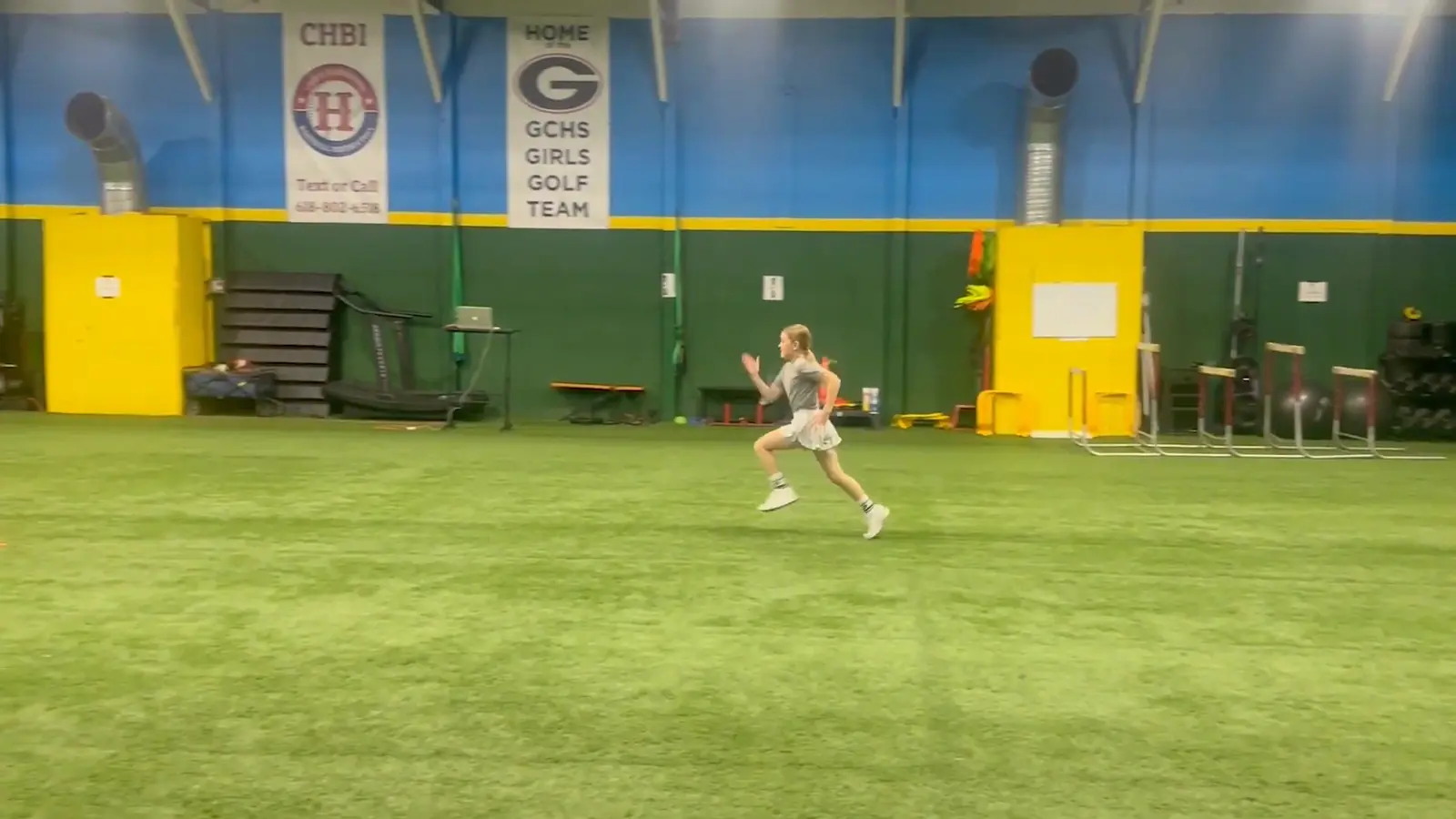
Block starts, the drive phase, arm action, ground contact. Elite Speed coaches sprinting as a skill, on indoor turf in Granite City, Illinois.
5.0 from 11 Google reviewsFirst session $0From $30 a month
[ 01 ] Tenths
Can a sprinter be coached faster?
Elite Speed trains track athletes in Granite City, Illinois on the mechanics of sprinting: posture, arm action, knee drive and ground contact. A sprinter does not get faster by running more. They get faster by running better, and that is a coaching problem, not a conditioning one.
The IHSA holds the Illinois boys track and field state finals on May 28 to 30, 2026 and the girls finals on May 21 to 23, 2026, both at Eastern Illinois University. Sprint mechanics are the one thing you can still change between now and then.
Sprinting is a skill with a technique, exactly like a swing or a jump shot, and it is the one skill almost nobody teaches. Most high school sprinters run the way they ran in fifth grade, a little stronger, and assume the number on the clock is who they are. It usually is not. It is usually posture, or an arm swing crossing the body, or a foot landing eight inches in front of the hips and braking on every step.
Where the time hides
In a hundred meters there are three separate problems, and an athlete can be good at one and terrible at another.
- The start. Angles out of the blocks, and the patience to stay low through the drive phase instead of popping upright in three steps.
- Acceleration. The first three steps, then the next ten. This is the block that carries over to every other sport an athlete plays.
- Top-end mechanics. Arm action, knee drive and ground contact time, which is where a fast athlete becomes a fast sprinter.
- Holding form when tired. Most races are lost in the last twenty meters by mechanics falling apart, not by the engine running out.
Year round, indoors
The metro-east track season is short and the weather takes half of it. Elite Speed trains on indoor turf on Horseshoe Lake Road, so a sprinter can work mechanics in December and January when the track is unusable. Athletes come here from Granite City, Edwardsville, Collinsville, Belleville, O’Fallon, Glen Carbon, Troy, Maryville and Alton. Groups run 1 to 15, which is the only way a coach can watch one athlete’s feet and mean it.
[ 02 ] Where the time hides
Three places a sprinter loses tenths
A race is three skills, run in order, and each one is coached differently.
- 01Out of the blocks
Coming up too early wastes the best acceleration an athlete has. Staying low through the drive phase is a position, and positions can be taught.
- 02Arm action and ground contact
Arms set the rhythm the legs follow, and a foot that lands in front of the hips brakes every stride. Both are correctable in a session.
- 03Form under fatigue
Races are usually lost when mechanics come apart in the last twenty, not when the engine quits. Trained form holds together longer than untrained form.
[ 03 ] A runner’s hour
How the hour is spent
For a track athlete the warm-up and the speed block are not preparation for the sport. They are the sport.
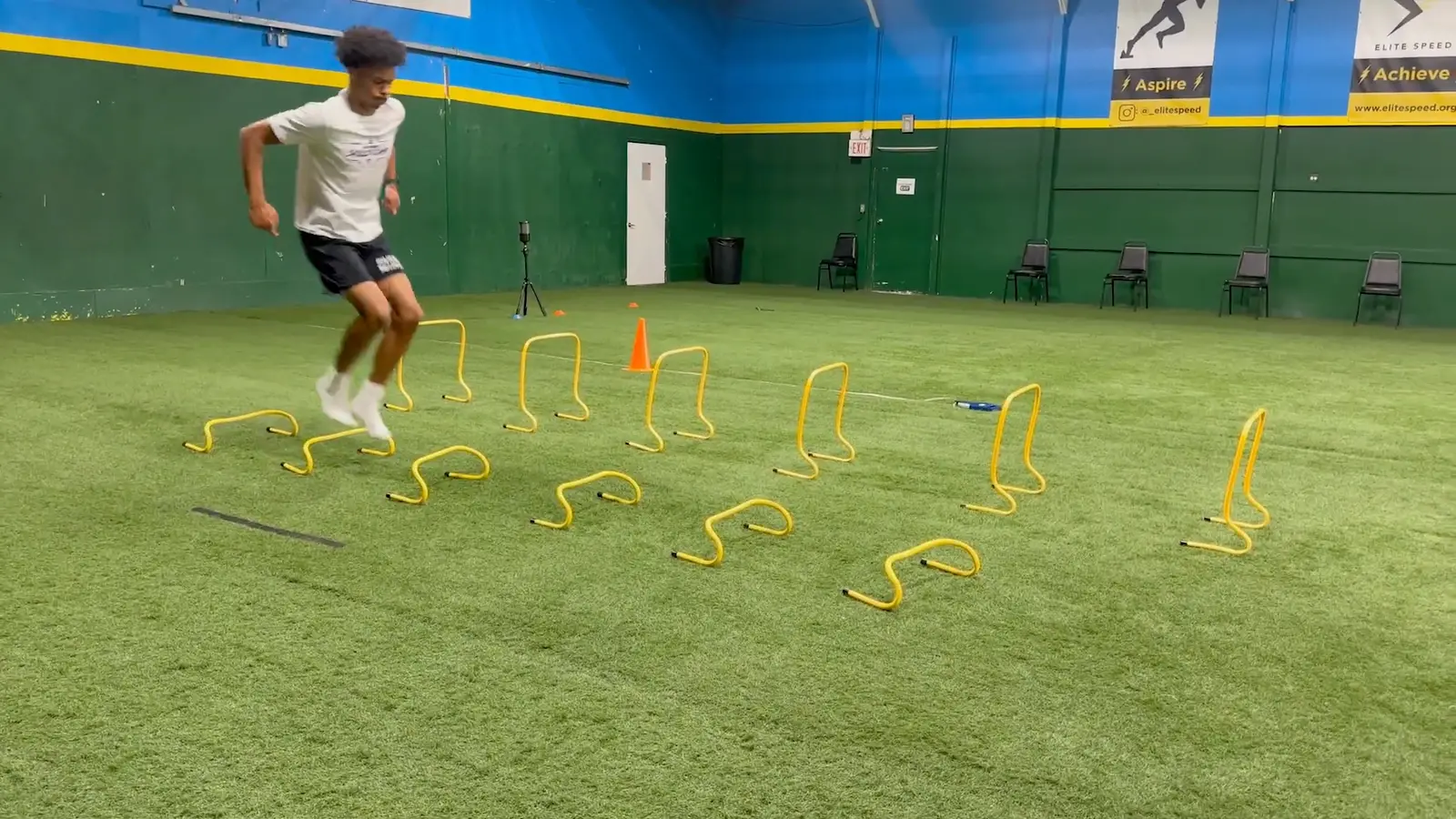
Dynamic warm-up
Every session opens the same way. For a sprinter this part is not optional, because the positions you cannot reach warm are the positions you will never hold at full speed.
Speed and agility work
Footwork, running form, and the first three steps out of a stance. It is the same foundation every athlete here trains, and for a track athlete it is the event itself.
One correction at a time
Coaches take time with each athlete to fine-tune technique. One runner, one cue, then the next one. Nothing changes when a kid gets six corrections at once, so they do not get six.
[ 04 ] Questions
Runners ask these
How do I run faster?
Elite Speed coaches three things, in order: posture, arm action and ground contact. Run tall with your hips underneath your ribs so the force you make goes forward instead of leaking upward, drive your elbows back rather than punching them forward, and land your foot underneath your body instead of reaching out in front of it.
Spend less time on the ground each step by pushing back and down instead of pulling yourself along. Add hip and hamstring strength so you can hold that position at full speed, and take full recovery between sprints, because speed is built fresh and lost tired. Running more miles will not do any of this. Someone watching your mechanics and correcting one thing at a time will.
Can sprint mechanics actually be coached?
Yes. Sprinting is a skill with a technique, the same as a swing or a jump shot. Most athletes have never been taught it, so they run the way they ran as a kid and assume that is their ceiling. Elite Speed coaches arm action, knee drive, posture and ground contact in groups of 1 to 15.
When should a track athlete work on sprint mechanics?
The off-season is where mechanics change most, because there is no meet at the end of the week to protect. That said, Elite Speed runs a flexible membership rather than a season, so plenty of sprinters keep training right through the spring. Athletes come when their schedule allows.
What ages does Elite Speed train for track?
The speed and agility class is built for ages 13 and up, in groups of 1 to 15 athletes. Younger runners train in the general speed program, where coaches scale the work to the athlete. Elite Speed trains athletes from youth through high school and beyond.
What does track speed training cost at Elite Speed?
Group speed and agility starts at $30 a month, a single drop-in class is $30, and memberships run from $30 to $480 a month depending on the program. The first session is free, so your athlete can try the training before anyone pays anything.
[ 05 ] Start here
Bring your runner. Watch one session.
The first one is free and there is nothing to sign. You will see the drills, you will see the energy, and you will know inside an hour whether this is your spot.
5.0 from 11 Google reviewsFirst session $0From $30 a month