Lateral
Staying in front
A defensive slide breaks down at the hips and the ankles first. Fix the position and the same athlete suddenly guards people they used to lose.

Home / Basketball speed training
Basketball speed is start, stop, slide, turn, start again. Elite Speed coaches the footwork that decides all four, in Granite City, Illinois.
5.0 from 11 Google reviewsFirst session $0From $30 a month
[ 01 ] Not straight-line
Elite Speed trains basketball players in Granite City, Illinois on footwork, running form and the first three steps. On a court that becomes a faster defensive slide, a first step that beats a closeout, and the ability to stop and change direction without giving the whole play away.
The IHSA has the Illinois high school boys basketball state finals on March 12 to 14, 2026 at the State Farm Center in Champaign. A season that long is decided by who can still change direction in the fourth quarter of the last game.
Straight-line running is a small part of a basketball night. The game is start, stop, slide, turn and start again, hundreds of times, and the athlete who wins those exchanges is usually the one who can decelerate best, not the one with the prettiest forty time. Stopping is a skill. Almost nobody trains it.
A slide that turns into a crossover is a blow-by. A closeout with the feet underneath is a contest; the same closeout out of control is a foul. Guarding somebody is a sequence of small, fast, correctable movements, and correctable is the important word. Elite Speed coaches groups of 1 to 15 athletes so somebody is actually watching your kid’s feet instead of running the whole floor through a stopwatch.
The three seconds after a rebound decide more possessions than any set play. That window is pure acceleration mechanics: how fast an athlete gets from a standstill to full speed, then how well they hold their body together to finish. Both halves of that are trainable.
Athletes come to this building from Granite City, Edwardsville, Collinsville, Belleville, O’Fallon, Glen Carbon, Troy, Maryville and Alton, and it is all indoor turf, so a winter schedule changes nothing.
[ 02 ] Four movements
A player is rarely in a straight line for long. These are the four things that fill the rest of the night.
Hips, ankles and foot placement, so a defensive slide stays a slide.
Stopping, planting and going the other way without a wasted step in between.
The first three steps out of a stop, which is where a fast break is won or lost.
Better ground contact and lower-body coordination, the things underneath every jump.
[ 03 ] Start, stop, slide
Three movements, repeated all night, and none of them are a sprint.
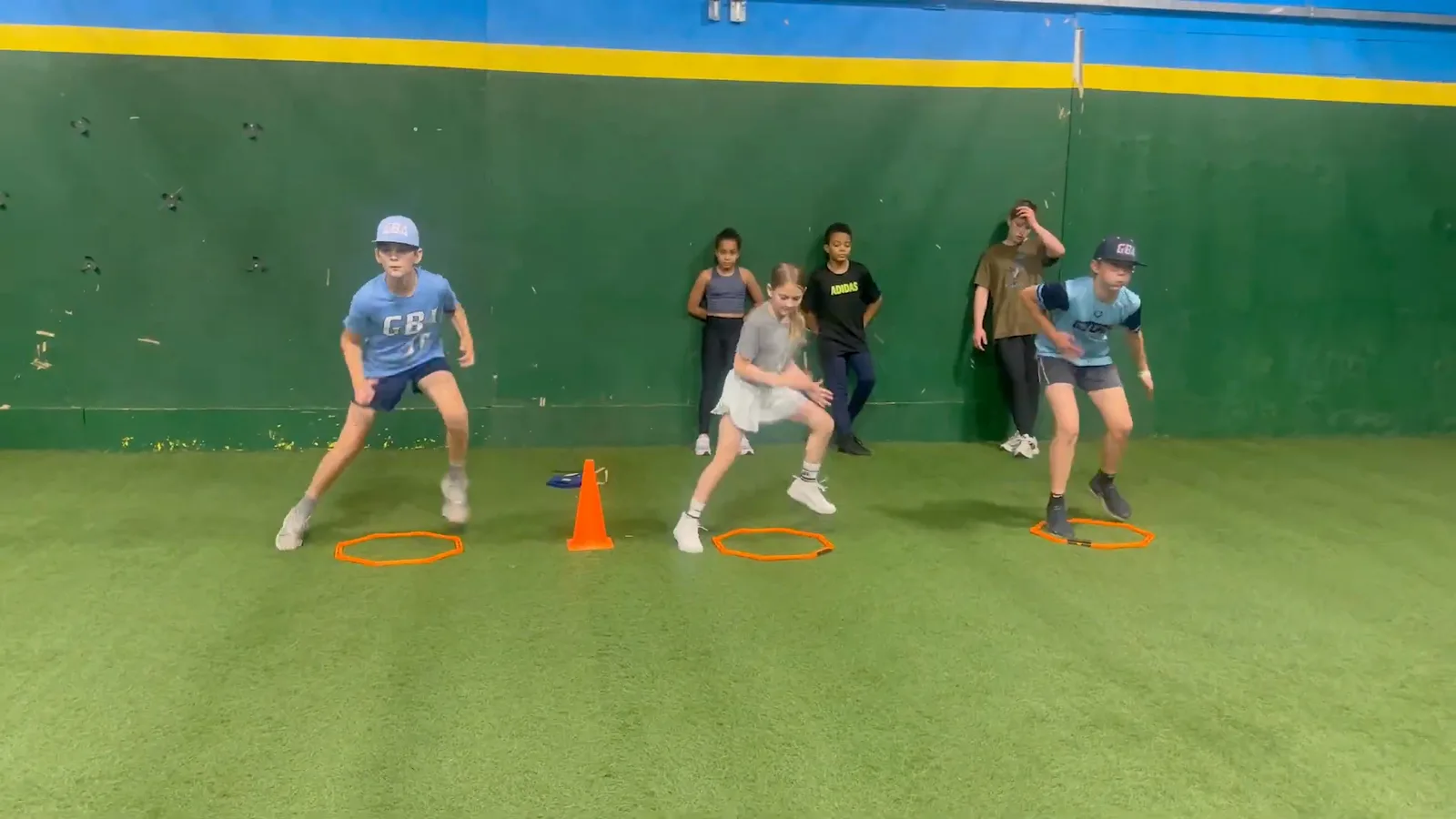
Lateral
A defensive slide breaks down at the hips and the ankles first. Fix the position and the same athlete suddenly guards people they used to lose.
Deceleration
Changing direction starts with stopping, and stopping is the least-coached skill in the sport. Train it and every cut, closeout and jab step gets sharper.
Transition
A fast break is won in the first second after a rebound. That is acceleration mechanics, and acceleration mechanics are teachable.
[ 04 ] The order of work
Nothing is improvised. The same three blocks, in the same order, every session your kid walks into.
Every session opens the same way. Hips, ankles and everything else get ready to move, which for a basketball player is not a warm-up detail, it is the joint that everything else runs through.
Footwork, running form, and the first three steps out of a stance. It is the same foundation every athlete in this building trains, and on a court it shows up as slides, closeouts and cuts.
Coaches take time with each athlete to fine-tune technique. One kid, one thing, then the next thing. That is the whole difference between coaching and a highlight reel of drills.
[ 05 ] Questions
Yes, and mostly in ways a straight-line sprint never shows. Basketball is start, stop, slide and turn, over and over. Elite Speed coaches footwork, running form and the first three steps, which is the first move on a closeout, the slide that stays in front of a driver, and stopping under control instead of drifting past the play.
Jumping is a force and coordination problem, so better lower-body mechanics generally help. Elite Speed will not promise you inches, because nobody honest can. What coaches will do is fix how your athlete loads, lands and pushes against the ground, which is where explosiveness actually comes from.
The speed and agility class is built for ages 13 and up, in groups of 1 to 15 athletes. Younger players train in the general speed program, where coaches scale the work to the athlete. Elite Speed trains athletes from youth through high school and beyond.
Yes. Elite Speed runs a flexible membership rather than a season-long contract, so athletes come when their schedule allows. Training runs Monday through Thursday from 4pm to 9pm and Saturday from 9am to noon, and the turf is indoors, so a January schedule changes nothing.
Group speed and agility starts at $30 a month, a single drop-in class is $30, and memberships run from $30 to $480 a month depending on the program. The first session is free, so your athlete can try the training before anyone pays anything.
[ 06 ] Start here
The first one is free and there is nothing to sign. One hour on the turf and you will know whether this is where your kid gets quicker on the floor.
5.0 from 11 Google reviewsFirst session $0From $30 a month