Repeatability
The eighty-ninth minute
The sprint that matters is usually the last one. Efficient running form is what leaves something in the tank for it.

Home / Soccer speed training
A match is ninety minutes of jogging with the game hidden inside the sprints. Elite Speed coaches the mechanics that make each one faster and cheaper.
5.0 from 11 Google reviewsFirst session $0From $30 a month
[ 01 ] Forty sprints
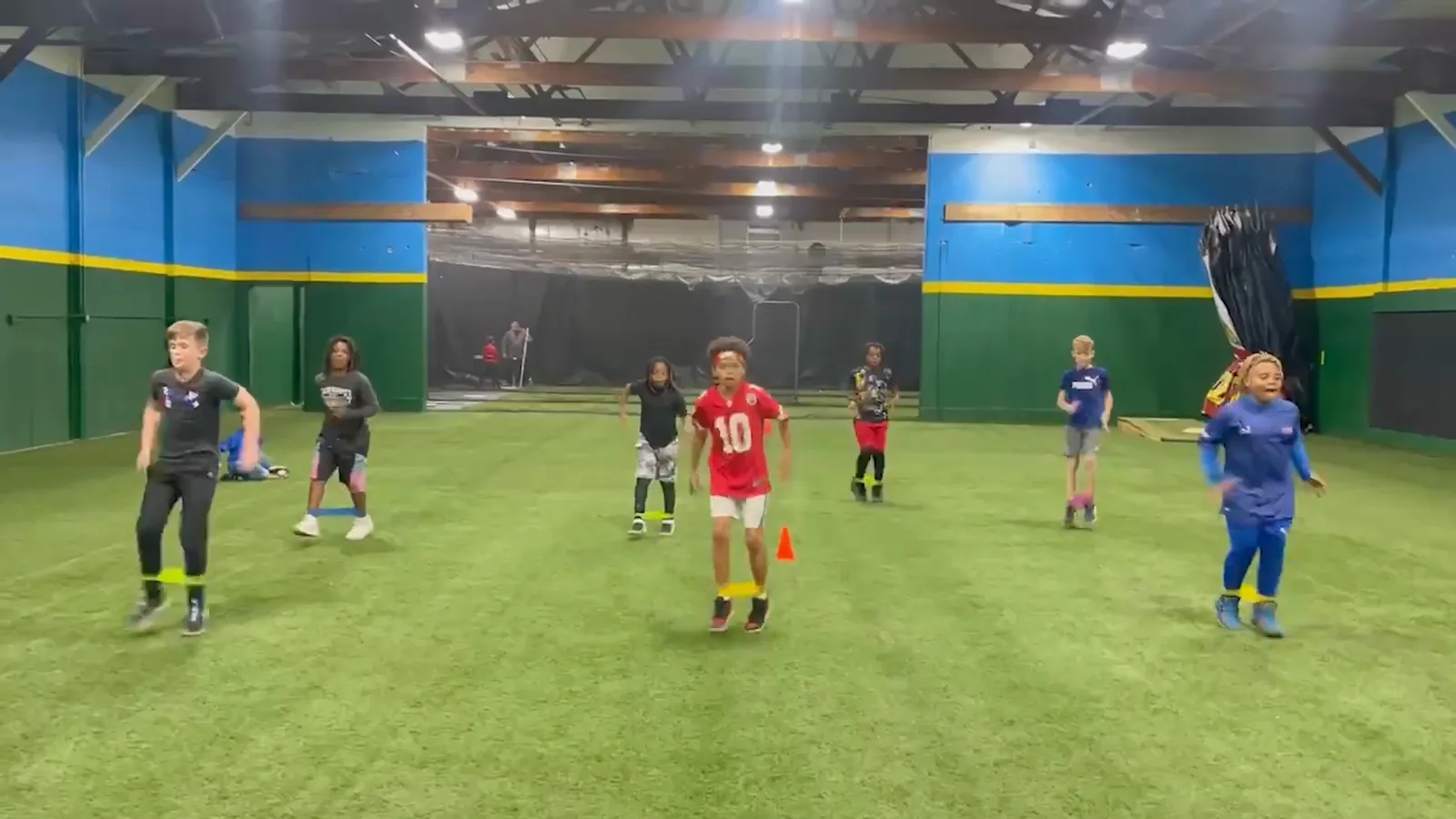
Elite Speed trains soccer players in Granite City, Illinois on footwork, running form and the first three steps. For a soccer player the payoff is repeatability: the same acceleration out of a cut in the eighty-ninth minute that you had in the fifth, and the mechanics to keep producing it.
The IHSA finishes the Illinois boys soccer state series on November 5 to 7, 2026 and the girls series on June 3 to 5, 2027. Two different calendars, the same repeat-sprint problem underneath both.
Soccer speed is not one sprint. It is dozens of them, separated by jogging, standing and backpedaling, and the one that decides the match is almost always late. An athlete who runs efficiently spends less on every repetition, which means the last sprint looks like the first one. An athlete with sloppy mechanics pays a tax on every single burst and runs out before the whistle does.
Almost nothing in soccer starts from a clean standing position. Players accelerate out of a turn, off the wrong foot, with a defender leaning on them. That is a footwork problem: where the feet land coming out of the plant, whether the hips are square, whether the first two steps go forward or sideways. Fix those and a player is suddenly a step clear in situations where they used to be a step behind.
Players come to this building from Granite City, Edwardsville, Collinsville, Belleville, O’Fallon, Glen Carbon, Troy, Maryville and Alton. The turf is indoors, which matters in a sport whose fields spend three months of the year unplayable.
[ 02 ] Three blocks
An hour that never turns into fitness punishment. Your player is being coached the whole time.
Every session opens the same way. Hips and ankles get prepared to do real work, which is also the cheapest injury insurance a young soccer player can get.
Footwork, running form, and the first three steps out of a stance. Same foundation as every athlete here, and on a pitch it turns into acceleration out of a turn and a cleaner recovery run.
Coaches take time with each athlete to fine-tune technique. One player, one thing, then the next thing. Nobody is getting run in circles to look busy.
[ 03 ] The eighty-ninth minute
Three things decide most of the speed in a match, and none of them are cardio.
Repeatability
The sprint that matters is usually the last one. Efficient running form is what leaves something in the tank for it.
Out of the cut
Soccer players accelerate off a plant, not out of blocks. Where the feet land coming out of that turn is the whole difference.
Control
An extra step to change direction is an extra step for the defender. Deceleration is trainable and hardly anybody trains it.
[ 04 ] Questions
Yes, because running a lot and running well are different problems. A soccer player covers miles in a match but wins or loses on the short sprints inside it. Elite Speed coaches running form, footwork and the first three steps, so each of those sprints is faster and costs less energy than it used to.
Elite Speed soccer training is coaching, not conditioning. Their club already runs them into the ground, so sessions here work mechanics: arm action, knee drive, ground contact and the first three steps out of a stance. Groups run 1 to 15, so a coach watches one athlete at a time.
The speed and agility class is built for ages 13 and up, in groups of 1 to 15 athletes. Younger players train in the general speed program, where coaches scale the work to the athlete. Elite Speed trains athletes from youth through high school and beyond.
Yes. Elite Speed runs a flexible membership rather than a season-long contract, so athletes come when their schedule allows. Training runs Monday through Thursday from 4pm to 9pm and Saturday from 9am to noon, on indoor turf, which is useful when a field in February is not.
Group speed and agility starts at $30 a month, a single drop-in class is $30, and memberships run from $30 to $480 a month depending on the program. The first session is free, so your athlete can try the training before anyone pays anything.
[ 05 ] Start here
The first one is free and there is nothing to sign. You will see the drills, you will see the energy, and you will know inside an hour whether this is your spot.
5.0 from 11 Google reviewsFirst session $0From $30 a month